Skip to content

Scatter

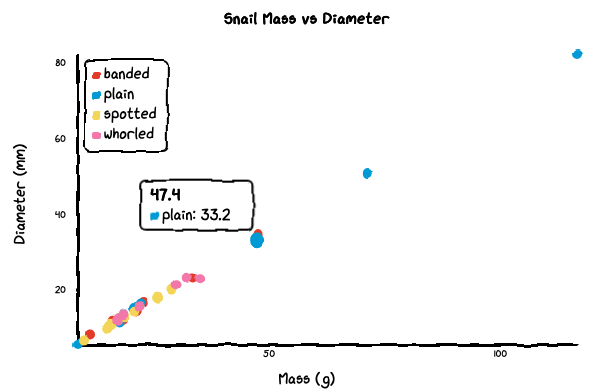
Scatter plot.

Scatter

Bases: _AxisChart

Scatter plot with numeric or temporal x-axis.

Unlike other axis charts, Scatter does not use a labels array. Each dataset contains {x, y} points directly. Adding an r field to any point activates bubble mode: dot radii are scaled by r using a square-root scale so area encodes magnitude.

Parameters:

Name Type Description Default
title str | None

Chart title.

None
x_label str | None

Label for the x-axis.

None
y_label str | None

Label for the y-axis.

None
datasets Any

List of dataset dicts, each with data (list of {"x": number, "y": number} or {"x": number, "y": number, "r": number} dicts for bubble mode), label (str), and an optional color (str) key.

required
options Any

Dict of chart options.

None

Options:

  • backgroundColor (str): Background color (default 'white').
  • dataColors (list[str]): Point/line colors.
  • dotSize (float): Base dot size multiplier (default 1).
  • fontFamily (str): Font family (default 'xkcd').
  • legendPosition (int): Legend placement (use positionType).
  • showLegend (bool): Show legend (default True).
  • showLine (bool): Connect dots with lines (default False).
  • strokeColor (str): Axis/border color (default 'black').
  • timeFormat (str): dayjs format string for temporal x-axis.
  • unxkcdify (bool): Disable hand-drawn style (default False).
  • xMin (float): Minimum x-axis value.
  • xMax (float): Maximum x-axis value.
  • xRef (list[dict]): Vertical reference lines. Each entry is {"value": <number>, "label": <annotation-text>}.
  • xTickCount (int): Number of x-axis ticks (default 3).
  • yMin (float): Minimum y-axis value.
  • yMax (float): Maximum y-axis value.
  • yRef (list[dict]): Horizontal reference lines. Each entry is {"value": <number>, "label": <annotation-text>}.
  • yTickCount (int): Number of y-axis ticks (default 3).

Example — scatter with reference lines::

Scatter(
    title="Scatter",
    x_label="X",
    y_label="Y",
    datasets=[{
        "label": "Series A",
        "data": [{"x": 1, "y": 2}, {"x": 3, "y": 5}],
    }],
    options={
        "yRef": [{"value": 3.5, "label": "median"}],
    },
)

Example — bubble chart::

Scatter(
    title="Bubbles",
    datasets=[{
        "label": "Population",
        "data": [
            {"x": 1, "y": 2, "r": 10},
            {"x": 3, "y": 5, "r": 30},
        ],
    }],
)
Source code in src/chart_xkcd/scatter.py
  7
  8
  9
 10
 11
 12
 13
 14
 15
 16
 17
 18
 19
 20
 21
 22
 23
 24
 25
 26
 27
 28
 29
 30
 31
 32
 33
 34
 35
 36
 37
 38
 39
 40
 41
 42
 43
 44
 45
 46
 47
 48
 49
 50
 51
 52
 53
 54
 55
 56
 57
 58
 59
 60
 61
 62
 63
 64
 65
 66
 67
 68
 69
 70
 71
 72
 73
 74
 75
 76
 77
 78
 79
 80
 81
 82
 83
 84
 85
 86
 87
 88
 89
 90
 91
 92
 93
 94
 95
 96
 97
 98
 99
100
class Scatter(_AxisChart):
    """Scatter plot with numeric or temporal x-axis.

    Unlike other axis charts, Scatter does not use a ``labels`` array. Each
    dataset contains ``{x, y}`` points directly. Adding an ``r`` field to
    any point activates bubble mode: dot radii are scaled by ``r`` using a
    square-root scale so area encodes magnitude.

    Args:
        title: Chart title.
        x_label: Label for the x-axis.
        y_label: Label for the y-axis.
        datasets: List of dataset dicts, each with ``data`` (list of
            ``{"x": number, "y": number}`` or ``{"x": number, "y": number,
            "r": number}`` dicts for bubble mode), ``label`` (str), and
            an optional ``color`` (str) key.
        options: Dict of chart options.

    Options:

    - ``backgroundColor`` (str): Background color (default ``'white'``).
    - ``dataColors`` (list[str]): Point/line colors.
    - ``dotSize`` (float): Base dot size multiplier (default 1).
    - ``fontFamily`` (str): Font family (default ``'xkcd'``).
    - ``legendPosition`` (int): Legend placement (use ``positionType``).
    - ``showLegend`` (bool): Show legend (default True).
    - ``showLine`` (bool): Connect dots with lines (default False).
    - ``strokeColor`` (str): Axis/border color (default ``'black'``).
    - ``timeFormat`` (str): dayjs format string for temporal x-axis.
    - ``unxkcdify`` (bool): Disable hand-drawn style (default False).
    - ``xMin`` (float): Minimum x-axis value.
    - ``xMax`` (float): Maximum x-axis value.
    - ``xRef`` (list[dict]): Vertical reference lines. Each entry is
      ``{"value": <number>, "label": <annotation-text>}``.
    - ``xTickCount`` (int): Number of x-axis ticks (default 3).
    - ``yMin`` (float): Minimum y-axis value.
    - ``yMax`` (float): Maximum y-axis value.
    - ``yRef`` (list[dict]): Horizontal reference lines. Each entry is
      ``{"value": <number>, "label": <annotation-text>}``.
    - ``yTickCount`` (int): Number of y-axis ticks (default 3).

    Example — scatter with reference lines::

        Scatter(
            title="Scatter",
            x_label="X",
            y_label="Y",
            datasets=[{
                "label": "Series A",
                "data": [{"x": 1, "y": 2}, {"x": 3, "y": 5}],
            }],
            options={
                "yRef": [{"value": 3.5, "label": "median"}],
            },
        )

    Example — bubble chart::

        Scatter(
            title="Bubbles",
            datasets=[{
                "label": "Population",
                "data": [
                    {"x": 1, "y": 2, "r": 10},
                    {"x": 3, "y": 5, "r": 30},
                ],
            }],
        )
    """

    def __init__(
        self,
        *,
        title: str | None = None,
        x_label: str | None = None,
        y_label: str | None = None,
        datasets: Any,
        options: Any = None,
    ):
        if not isinstance(datasets, (list, tuple)) or len(datasets) == 0:
            raise ValueError("Scatter: datasets must be a non-empty list")
        for i, ds in enumerate(datasets):
            if not isinstance(ds, dict) or "data" not in ds:
                raise ValueError(f"Scatter: datasets[{i}] must be a dict with a 'data' key")
            for j, pt in enumerate(ds["data"]):
                if not isinstance(pt, dict) or "x" not in pt or "y" not in pt:
                    raise ValueError(
                        f"Scatter: datasets[{i}].data[{j}] must be a dict "
                        f"with 'x' and 'y' keys"
                    )
        data = {"datasets": list(datasets)}
        super().__init__(
            title=title, x_label=x_label, y_label=y_label, data=data, options=options
        )

example