Skip to content

Line

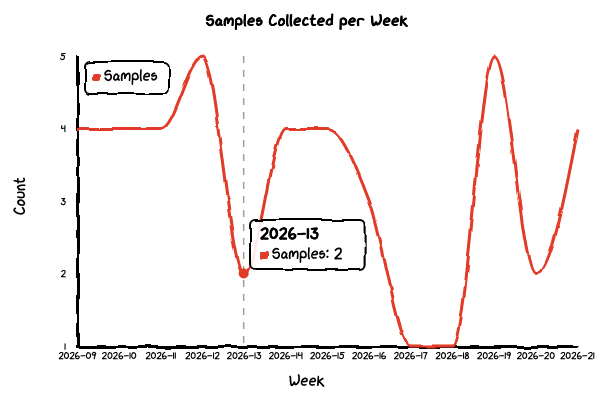
Line chart.

Line

Bases: _AxisChart

Line chart for continuous data with one or more lines.

Parameters:

Name Type Description Default
title str | None

Chart title.

None
x_label str | None

Label for the x-axis.

None
y_label str | None

Label for the y-axis.

None
labels Any

X-axis category labels.

required
datasets Any

List of dataset dicts, each with data (list of numeric values), label (str), and an optional color (str) key.

required
options Any

Dict of chart options.

None

Options:

  • backgroundColor (str): Background color (default 'white').
  • dataColors (list[str]): Line colors.
  • fontFamily (str): Font family (default 'xkcd').
  • legendPosition (int): Legend placement (use positionType).
  • showArea (bool): Fill the area under each line (default False).
  • showLegend (bool): Show legend (default True).
  • strokeColor (str): Axis/border color (default 'black').
  • unxkcdify (bool): Disable hand-drawn style (default False).
  • xRef (list[dict]): Vertical reference lines. Each entry is {"value": <x-label>, "label": <annotation-text>}.
  • yRef (list[dict]): Horizontal reference lines. Each entry is {"value": <number>, "label": <annotation-text>}.
  • yMin (float): Minimum y-axis value.
  • yMax (float): Maximum y-axis value.
  • yTickCount (int): Number of y-axis ticks (default 3).

Example::

Line(
    title="Temperature",
    x_label="Day",
    y_label="Degrees",
    labels=["Mon", "Tue", "Wed", "Thu"],
    datasets=[
        {"data": [65, 70, 68, 72], "label": "NYC"},
        {"data": [80, 82, 79, 85], "label": "LA"},
    ],
    options={
        "showArea": True,
        "yRef": [{"value": 75, "label": "target"}],
    },
)
Source code in src/chart_xkcd/line.py
 7
 8
 9
10
11
12
13
14
15
16
17
18
19
20
21
22
23
24
25
26
27
28
29
30
31
32
33
34
35
36
37
38
39
40
41
42
43
44
45
46
47
48
49
50
51
52
53
54
55
56
57
58
59
60
61
62
63
64
65
66
67
68
69
class Line(_AxisChart):
    """Line chart for continuous data with one or more lines.

    Args:
        title: Chart title.
        x_label: Label for the x-axis.
        y_label: Label for the y-axis.
        labels: X-axis category labels.
        datasets: List of dataset dicts, each with ``data`` (list of numeric
            values), ``label`` (str), and an optional ``color`` (str) key.
        options: Dict of chart options.

    Options:

    - ``backgroundColor`` (str): Background color (default ``'white'``).
    - ``dataColors`` (list[str]): Line colors.
    - ``fontFamily`` (str): Font family (default ``'xkcd'``).
    - ``legendPosition`` (int): Legend placement (use ``positionType``).
    - ``showArea`` (bool): Fill the area under each line (default False).
    - ``showLegend`` (bool): Show legend (default True).
    - ``strokeColor`` (str): Axis/border color (default ``'black'``).
    - ``unxkcdify`` (bool): Disable hand-drawn style (default False).
    - ``xRef`` (list[dict]): Vertical reference lines. Each entry is
      ``{"value": <x-label>, "label": <annotation-text>}``.
    - ``yRef`` (list[dict]): Horizontal reference lines. Each entry is
      ``{"value": <number>, "label": <annotation-text>}``.
    - ``yMin`` (float): Minimum y-axis value.
    - ``yMax`` (float): Maximum y-axis value.
    - ``yTickCount`` (int): Number of y-axis ticks (default 3).

    Example::

        Line(
            title="Temperature",
            x_label="Day",
            y_label="Degrees",
            labels=["Mon", "Tue", "Wed", "Thu"],
            datasets=[
                {"data": [65, 70, 68, 72], "label": "NYC"},
                {"data": [80, 82, 79, 85], "label": "LA"},
            ],
            options={
                "showArea": True,
                "yRef": [{"value": 75, "label": "target"}],
            },
        )
    """

    def __init__(
        self,
        *,
        title: str | None = None,
        x_label: str | None = None,
        y_label: str | None = None,
        labels: Any,
        datasets: Any,
        options: Any = None,
    ):
        _check_labels_datasets(labels, datasets, "Line")
        data = {"labels": list(labels), "datasets": list(datasets)}
        super().__init__(
            title=title, x_label=x_label, y_label=y_label, data=data, options=options
        )

example